
Explain yourself once.Work with whichever AI you want.
Room keeps your project’s important decisions and context available across AI conversations, so you can work with different models without starting over.

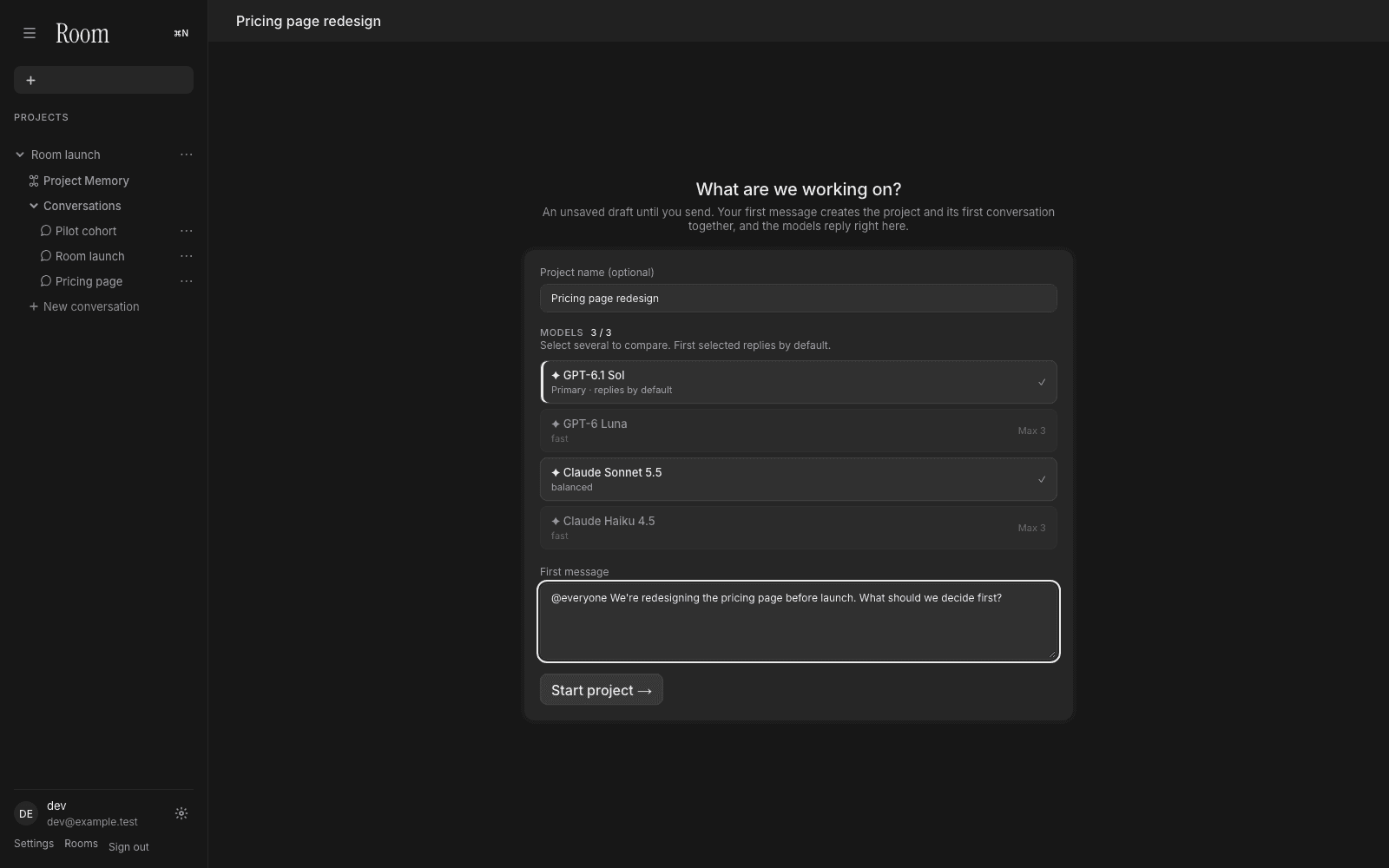
Captured from the Room app in early access
01 — The consistent context problem
Every AI conversation starts from zero.
You use different models for architecture, research, implementation and debugging. Each conversation learns something important. None of the others ever hear about it.
So you re-explain the stack, re-paste the constraints, and hope the decision you made last week survived the move between tabs. Project knowledge ends up scattered across transcripts, and nobody can say where a choice came from.
ArchitectureModel A
- Postgres, not Mongo
- Unknown here
- Unknown here
- Unknown here
ResearchModel B
- Unknown here
- Magic-link sign-in
- Unknown here
- Unknown here
ImplementationModel C
- Unknown here
- Unknown here
- Ship web first
- Unknown here
DebuggingModel D
- Unknown here
- Unknown here
- Unknown here
- No PII in logs
02 — Introducing Room
Room keeps the context. You choose the model.
Project Memory
- Postgres, not Mongo
- Magic-link sign-in
- Ship web first
- No PII in logs
4 confirmed · by you
01
One project, many conversations
Each project holds as many independent conversations as it needs. Transcripts stay private to the conversation they belong to.
02
Knowledge you confirmed, shared
Decisions, constraints, goals and open questions you approve live in the project, not in a single chat.
03
Any model, already briefed
Whichever model you bring in starts from the same confirmed understanding. No more pasting the context back in.
03 — Multi-model conversations
Ask one model. Or ask the room.
Address a model by its handle, a few at once, or everyone with @everyone. Each answers independently, side by side, from the same project knowledge. Room runs on your own OpenRouter key.
@everyone what should we decide first?
- GPT@gptAnswers
- Claude@claudeAnswers
- Gemini@geminiAnswers
04 — Project Memory
Decisions you confirm become the project’s memory.
Discuss
A decision comes up in conversation.
You talk it through with one model, or with several at once. Nothing is remembered yet. Conversations stay private to themselves.
Review
Room proposes it. Or you add it yourself.
After a turn settles, Room suggests durable project knowledge, each item with its source messages and the exact words it came from.
Confirm
Only what you keep becomes memory.
Keep confirms an item, Dismiss rejects it, and you can edit or add items directly. Nothing becomes authoritative without you.
Reuse
Another conversation starts already knowing.
Confirmed items are shared with every conversation in the project, whichever model you ask.
Attribute
Every answer can point to its source.
Models cite the item ids they relied on, and each item keeps its quote and source messages, so you can always see where knowledge came from.
Illustration of Room’s interface · example content
05 — The workspace
A workspace that stays where you left it.
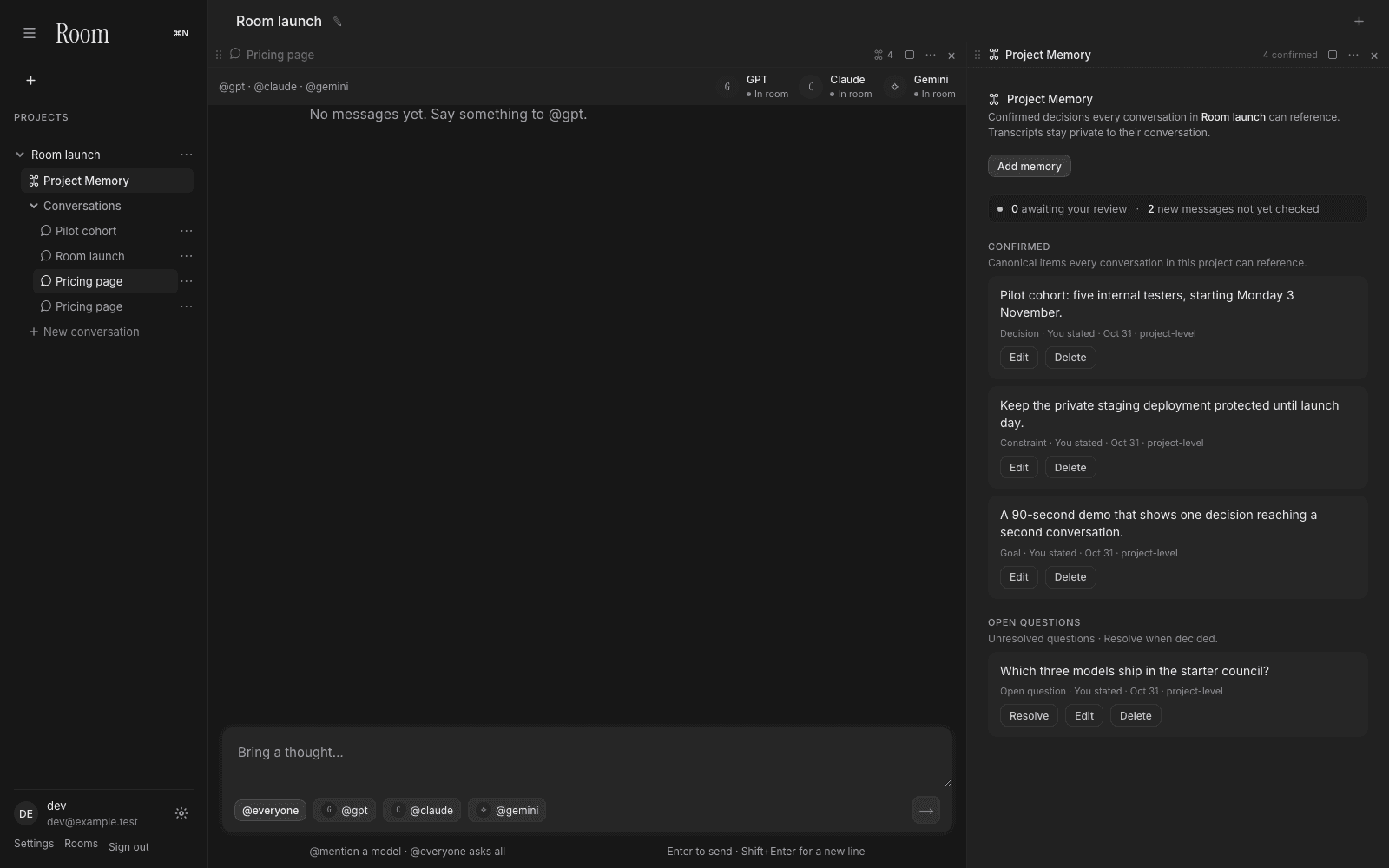
Projects and conversations
Every project keeps its own independent conversations.
A conversation
Talk to one model, several, or the whole room.
Project Memory, docked beside it
Confirmed decisions, constraints, goals and open questions.
Layout that stays
Dock, split and resize panels. The layout is saved with the project.
06 — Where Room is going
From shared context to agents that work inside it.
Room is being built to become the place where software gets made with AI: models and agents working from one persistent understanding of the project, with you deciding what they can do.
07 — Why Room exists
From the founder
I kept explaining the same project over and over.
Room came out of building software with several AI models at once. One was better for architecture, another for research, another for debugging. Each was useful on its own, but none of them knew what the others had helped me decide.
Every new chat meant re-explaining the stack and the constraints, and important decisions quietly went missing between tabs. I wanted one place where a project’s understanding lives, where I decide what counts, and where I can bring in whichever model fits the task. That is what Room is becoming.
Harthik MallichettyFounder, Room
Your ideas deserve a workspace that remembers.
Private early access. Joining the list doesn’t create an account.